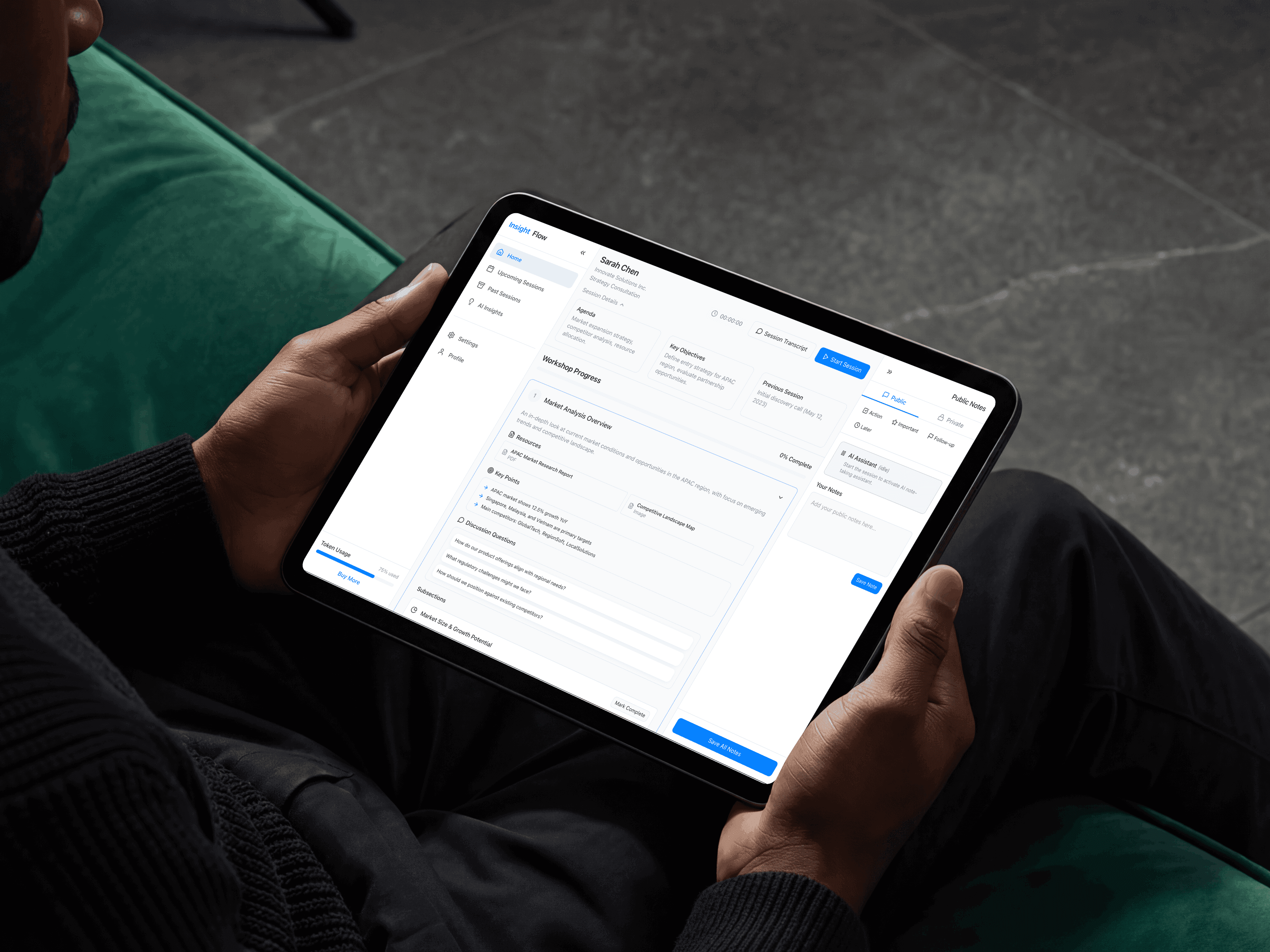
Insight Flow is a bespoke AI workspace engineered specifically for business consultants and enterprise strategists
By integrating real-time transcription, live insight generation, and contextual document retrieval into a single functional dashboard, the platform allows consultants to bypass administrative friction and focus entirely on active listening and strategic client guidance.
The initial brief presented a clear objective: build a system to support high-stakes client consultations
However, the underlying friction was deeply rooted in the cognitive capacity of the human operator.
The Dual-Task Penalty: Driving a complex, high-level conversation while simultaneously synthesising notes and manually hunting for reference documents actively degrades the quality of live client interactions.
Disruptive Mechanics: Traditional AI integrations rely on reactive chat interfaces. Requiring a consultant to manually type prompts into a system during a live meeting breaks eye contact and destroys conversational momentum.
• • The Technical Ceiling: Existing software acted as disjointed utilities rather than proactive partners, creating an intense administrative burden rather than alleviating it.
Before writing a single line of architectural logic, it was necessary to deconstruct the domain
Intensive requirement-gathering workshops and observational sessions with senior advisory teams mapped the reality of live workflows against overarching business goals.
The Competitor Landscape Market analysis revealed a significant gap. While competitors focused on bolting standard LLM chat windows onto existing dashboards, they failed to address the physical reality of a live pitch. The opportunity lay in engineering a digital workspace that acts as a silent, proactive partner—surface-level simple for the consultant, but technically sophisticated under the hood. Personas were mapped to balance the need for micro-level, real-time support for lead strategists with the macro-level pattern recognition required by agency directors.
Traditional methodologies would have spent weeks wireframing reactive chat interfaces and preparing a bloated developer handoff
Instead, the process moved directly into architectural prototyping using AI-driven development tools. This rapid build methodology allowed critical hypotheses to be tested in reality.
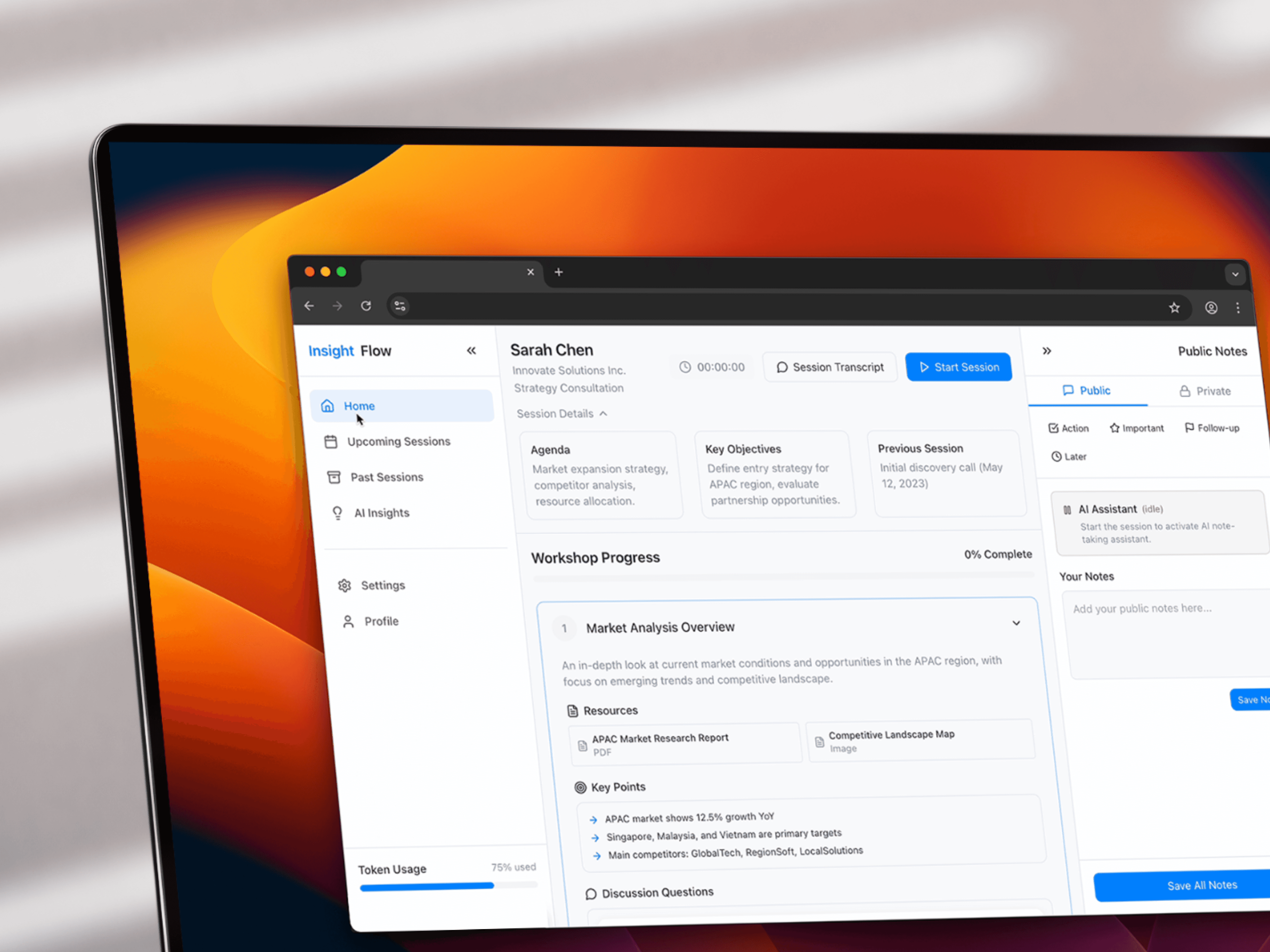
The system was architected around three core pillars determined during discovery:
Proactive Intelligence Feed: The architecture was pivoted entirely away from standard input/output models. The interface was engineered to automatically generate insights, extract key topics, and suggest historical references based solely on live audio transcription, requiring zero manual input.
Cognitive Load Distribution: The workspace is strategically divided to prevent visual overwhelm. The left hemisphere handles static, 'known' elements (agendas, live transcripts), while the right hemisphere manages dynamic, system-generated intelligence and suggested references.
Tactile & Explainable Automation: A "Silent Guidance" input mechanism was integrated, allowing strategists to discreetly steer the AI's analytical focus—flagging ideas for the system to expand upon later—without interrupting the client's train of thought or breaking visual engagement.
The primary advantage of generating functional prototypes is the ability to validate assumptions in a live environment rather than reviewing static screens
During simulated workshop testing, a critical behavioural pattern emerged. The initial build successfully captured data for post-session synthesis, but the lack of real-time contextual support left a gap in the consultant's immediate workflow.
Because the architecture was live, an immediate structural iteration was possible. The system was recalibrated to feature a dynamic 'Live Recommendation' engine. By processing the audio transcription with near-zero latency, the interface began surfacing contextual prompts and historical data mid-conversation. This specific iteration proved that live, automated updates significantly improved workshop performance, fundamentally transforming the platform from a passive recording tool into an active, strategic asset.
Looking back at the development of Insight Flow, the critical lesson was that designing for AI integration requires abandoning traditional software paradigms entirely
Bypassing static mockups to interact with live, simulated consultation data early on proved that reactive chat models fail in high-pressure environments.
The success of the platform stems from its ability to anticipate needs—structuring intelligence silently and surfacing it exactly when required. Furthermore, the process reinforced that in B2B environments, the interface must act as a seamless extension of the user's cognitive capacity. Building functional software at velocity allowed the true value of the tool to be realised: empowering the human operator rather than competing for their attention.