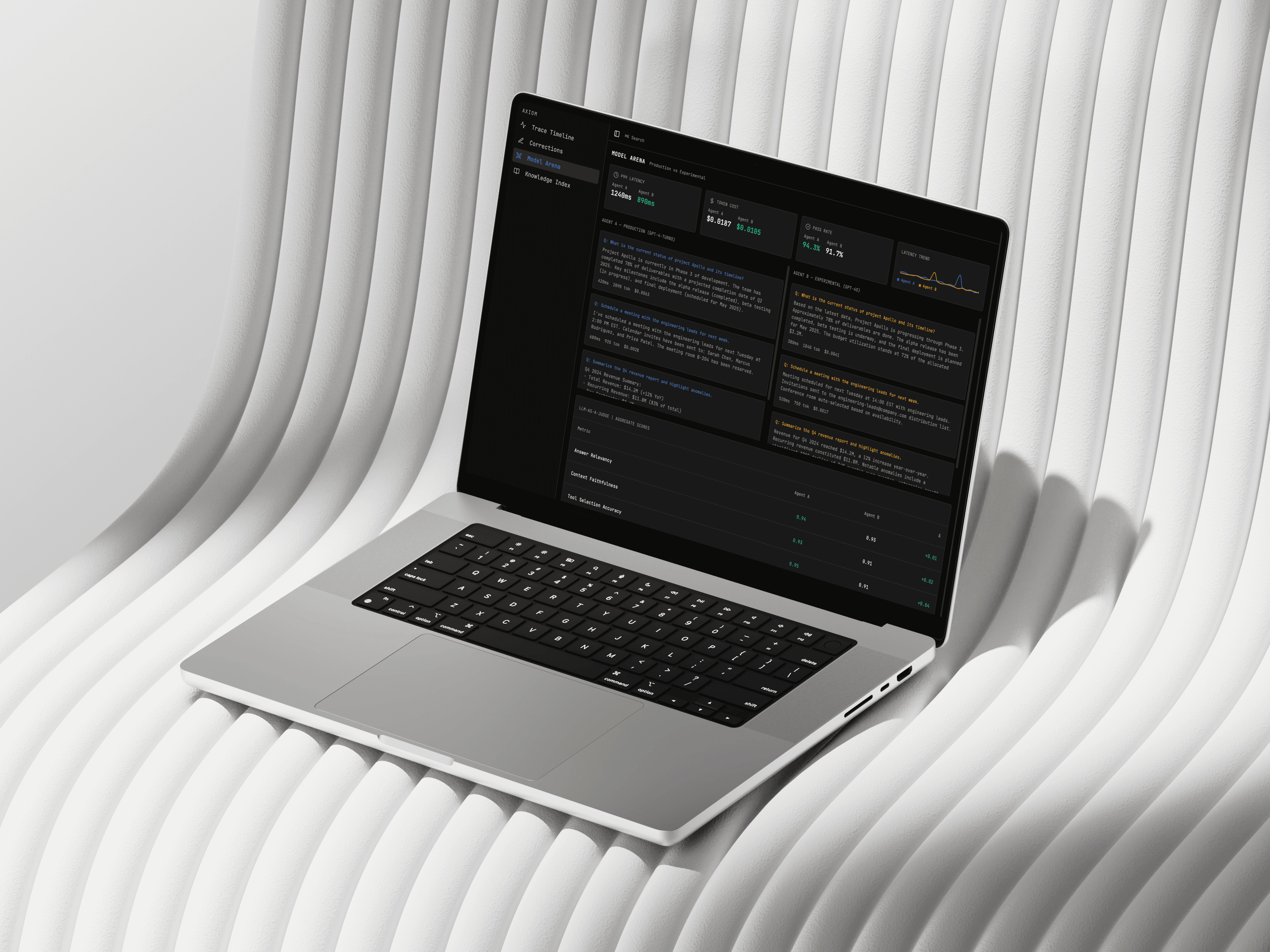
A product that monitors AI systems has a credibility problem before it renders a single pixel. It is making confident claims about something nobody can fully see.
Axiom is a monitoring platform for AI systems and autonomous agents: traces, corrections, retrieval, agent memory. The starting prototype presented itself as a control layer and ran entirely on static mock data. Trace views looked authoritative and changed nothing. Scores appeared without any scoring.
That gap is not unique to this product. It is the standard failure of observability tooling, where looking rigorous is much cheaper than being rigorous. The design question I ended up working on was narrower and more useful than adding features: what should this interface refuse to show?
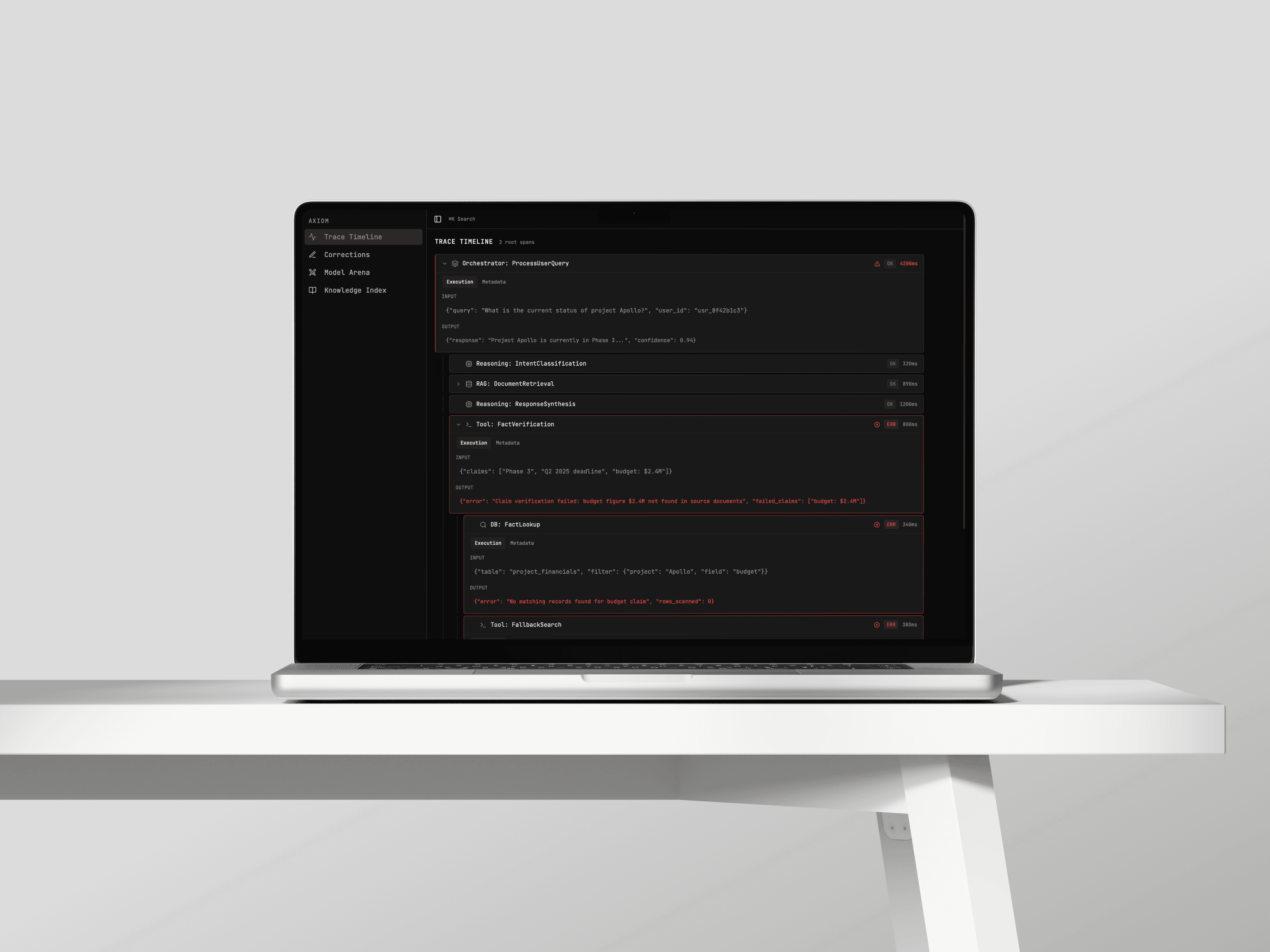
The Credible-Looking Trace: A trace view that renders beautifully and explains nothing is worse than no trace view, because it stops people asking the question.
Confidence That Never Ages: A memory entry marked 94% confident six hours ago is not 94% confident now, and an interface that shows the same number forever is quietly lying about freshness.
Predictions About Things That Have Not Happened: Showing the downstream impact of a correction before anyone has made a correction is a demo feature. It looks impressive and describes a world that does not exist yet.
The blast radius stays hidden until there is something to predict
Corrections in an agent system have consequences that spread. Change one instruction and downstream behaviour changes with it, sometimes in places nobody is watching. The Correction Impact panel exists to show that spread.
It renders only after a correction is submitted. Not on page load, not as a preview, not as a live estimate that updates while somebody types.
The version that renders on load demos better. It fills the screen, it shows the feature working, and it is the version most monitoring products would ship. It is also a picture of a hypothetical: a blast radius for a change that has not been made, presented in the same visual language as a blast radius for a change that has. Once an interface blurs that line, every number on the page becomes a maybe, and the user has no way to tell which are which.
Holding the panel back costs an empty state and buys the one thing a monitoring tool sells, which is that what it shows you happened.
Decay is a number on the screen, not a timestamp to interpret
The Memory Ledger tracks what an agent believes and how sure it is. Each entry carries a confidence value and a decay rate in percent per hour, with the status label derived from the confidence itself rather than from how long ago it was written.
The difference matters in practice. A timestamp asks the viewer to do the reasoning: it was captured four hours ago, the value moves quickly, so this is probably stale by now. Deriving the label from the current value does that reasoning in the system and shows the conclusion. An entry at 94% with 2% hourly decay reads as solid. One at 21% with 15% decay, an unverified figure from a failed fact-check, reads as something you should not act on, without the viewer needing to calculate anything.
Two smaller decisions in the same spirit
The anomaly panel sits as a third column in the app shell rather than as an overlay or a drawer. An overlay would cover the trace the user is reading and reset their scroll position when it closes. Investigating an anomaly means holding two things in view at once, so the layout has to allow that rather than swapping between them.
The trace narrator runs a deliberate 1.4 second generating state before returning its plain-English explanation. An instant response would read as a lookup, which is what most dashboards do. This one is producing an interpretation, and the short delay tells the user which kind of answer they are getting. Honest latency is a small idea and it changes how much weight people put on the result.
The standard it has to meet is the one it measures
Everything above comes from one position: a tool whose subject is AI trustworthiness cannot itself use the visual grammar of certainty for things it has inferred, predicted or made up for the demo. If it does, it is doing the exact thing it exists to catch.
The honest status: Axiom runs at cog-view.vercel.app, built solo in about two weeks. Every feature is clickable and every number is a fixture. There is no backend and no agent has ever been monitored with it. The confidence thresholds that drive the colour scales were set by eye, and I would want them calibrated against real traces before defending any of them. Refusing to display things I could not stand behind is the principle I would keep. Whether the specific numbers are right is untested.