Axiom

Axiom

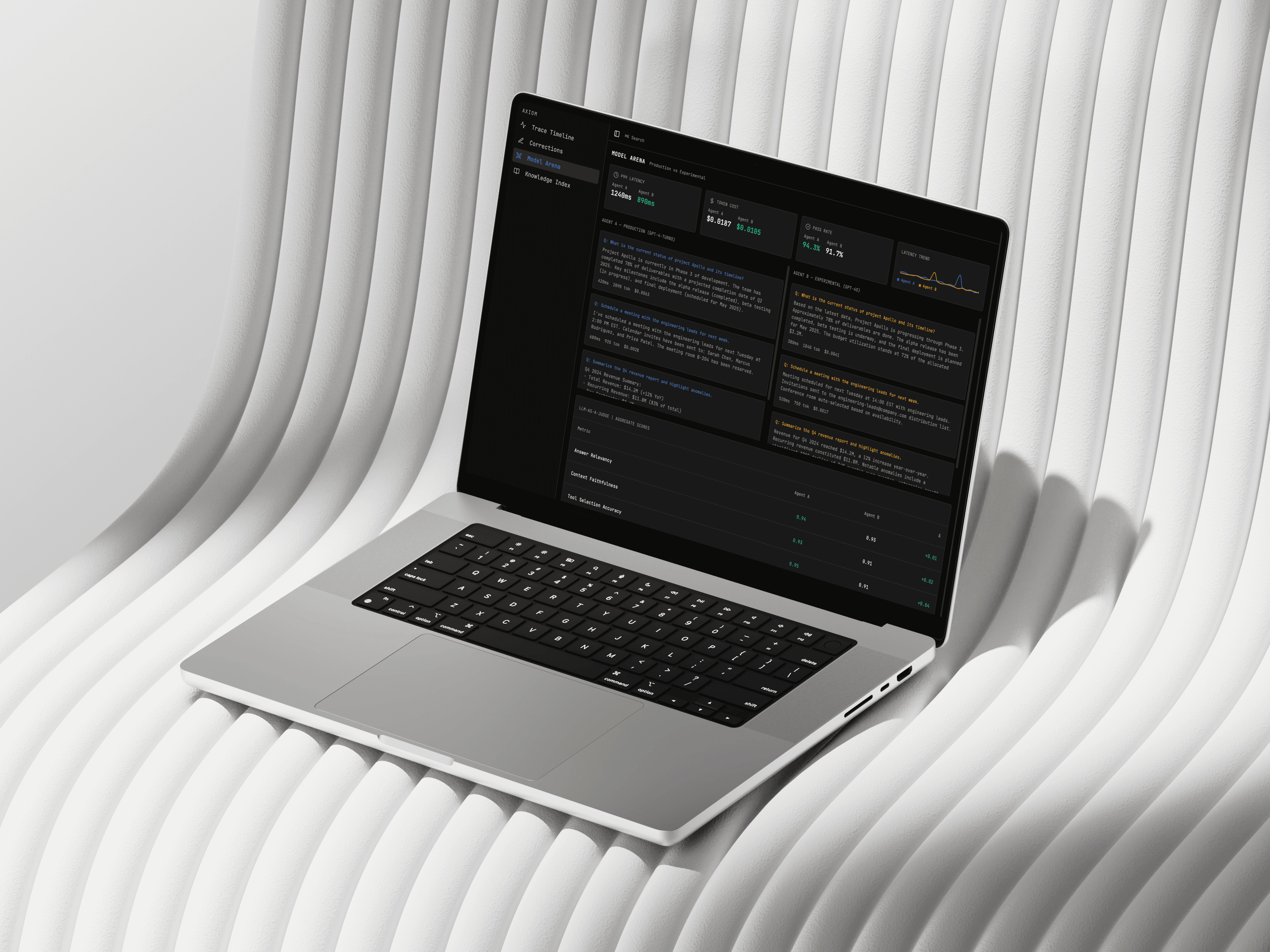
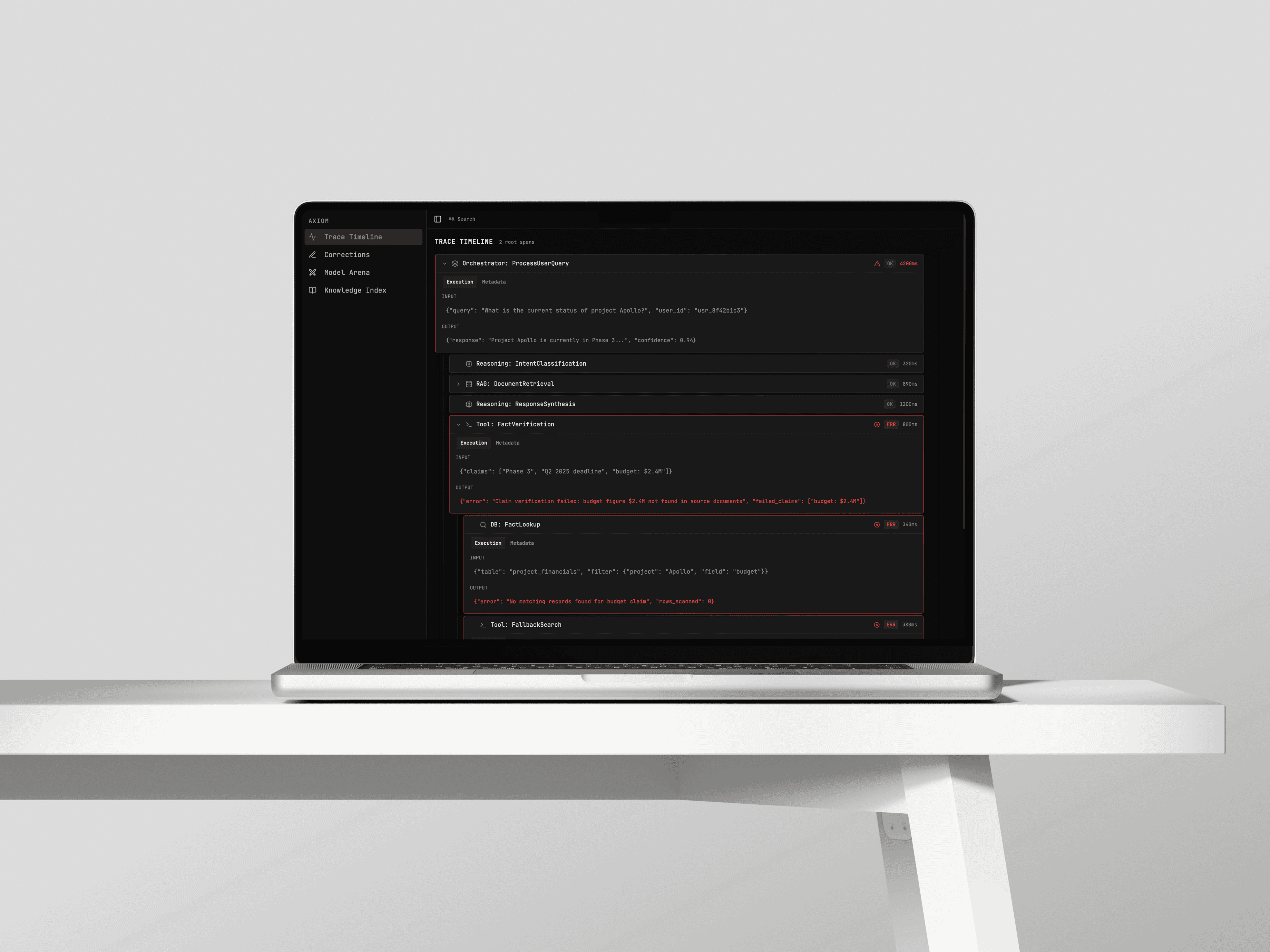
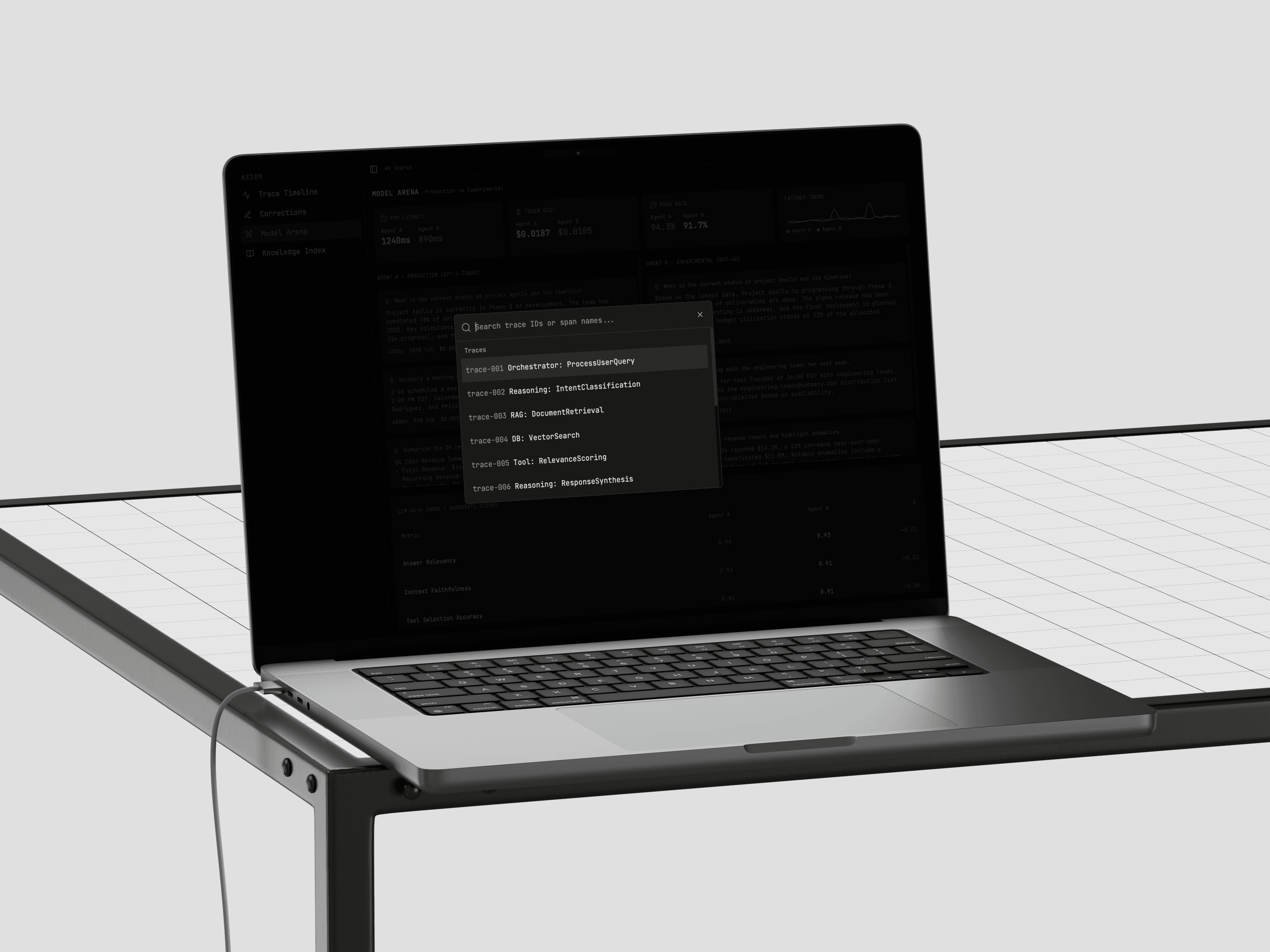
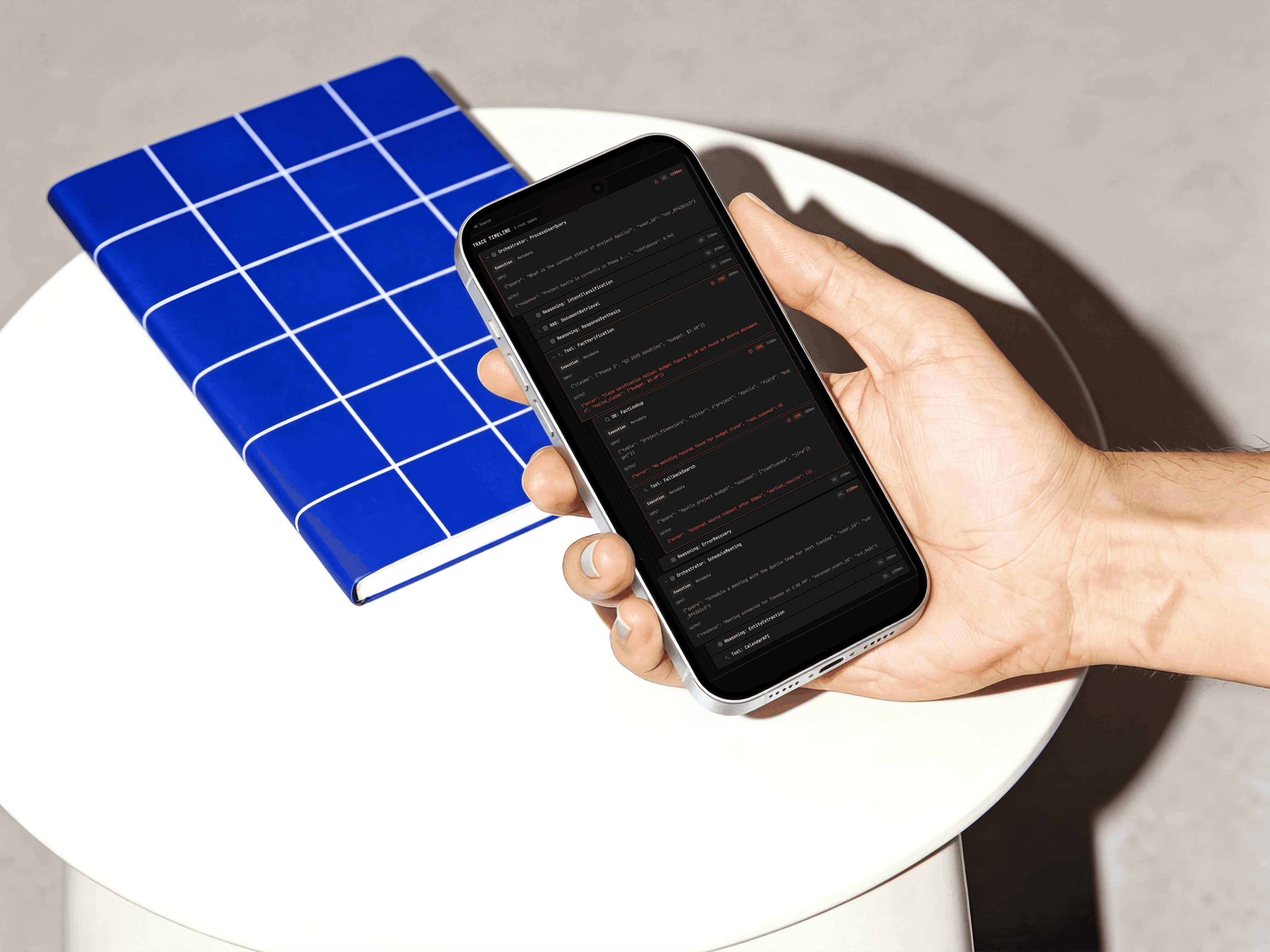
Axiom is a monitoring platform for AI systems and autonomous agents. It positioned itself as a control layer for agentic behaviour, but the prototype had no real intelligence of its own: static mock data, trace views that looked credible but changed nothing, and no live backend. The project was about closing that gap. A platform that monitors AI needs to demonstrably behave like one itself, not just display dashboards that look the part.

Year

02.26

Scope

Agent Integration, System Architecture

Timeline

2 weeks

Mission Control for the Era of Autonomous Agentic Systems

Axiom serves as the foundational infrastructure for the next generation of AI development, replacing raw terminal logs with a visual "X-ray" of agent reasoning.

Six capabilities identified

The AI features were scoped from product questions the existing UI surfaced but could not answer. Why did this trace fail? What happens downstream when a correction is submitted? Which document chunks are over-relied on or never retrieved? Six distinct capabilities emerged: an anomaly detection panel, a plain-English trace narrative generator, a correction blast-radius predictor, an LLM-as-judge scorer with visible reasoning, an agent memory state tracker with confidence decay, and a retrieval frequency heatmap over the RAG knowledge base.

Marcus Webb

Active-Duty Infantry

Monthly subscriber, auto-reorders his bag. Earns recognition, not rewards.

Monthly Subscriber

Auto-Reorder

Merch Buyer

Lena Carr

Veteran & Firefighter

Buys for her crew. Expects double points as a service member — no questions asked.

Veteran Verified

Group Orders

Reserve Roasts

🤖

Tyler Rosch

Civilian Fan

Found BRCC through social. Driven by challenges and levelling up his rank.

Challenge Hunter

New Roasts

Squad Member

Architecture before components

All six feature data shapes were defined in a single aiData.ts file before any component was written. TypeScript interfaces for anomalies, narratives, impact predictions, scorer reasoning, memory entries, and chunk heat entries. Realistic mock values followed: decay rates, co-retrieval maps, trigger phrases, confidence scores at different stages of staleness. This kept components stateless and swappable -- replace the mock with a real fetch and the component works unchanged. AI components were isolated in src/components/AI/ away from the existing shadcn/ui dashboard primitives.

Three structural decisions

The AnomalyPulse panel sits as a third flex column in the app shell rather than an overlay or drawer -- it does not disturb page scroll state and closes without losing the main content position. The TraceNarrator uses a three-state machine: idle, generating (1.4s simulated delay), done -- so the transition from button to expanded narrative feels like model inference rather than a data fetch. CorrectionImpact only renders after a correction is submitted, not on load: showing a blast radius for a change that has not happened yet would be misleading as an interface.

Decay as a first-class concept

The Memory Ledger introduces confidence decay as a visible metric -- each memory entry shows a fill bar that reflects the current confidence value and a decay rate in percent per hour. A memory at 94% confidence with a 2% hourly decay rate reads differently than one at 21% with 15% decay (the unverified budget figure from a failed fact-check). The status labels -- fresh, aging, stale -- are derived from confidence thresholds, not timestamps. This makes the freshness state of agent memory legible without requiring the viewer to calculate it themselves.

Live at cog-view.vercel.app

The deployed app now includes all six AI features in the existing four-view layout. The sidebar gained a Memory Ledger route. The header gained an Anomaly Pulse toggle. Model Arena opens on the Auto-Scorer tab by default. Knowledge Index has a Retrieval Heatmap tab. Corrections surfaces an impact panel after submission. The architecture separates AI mock data from UI components from routing, so any of the six features can be connected to a real API independently when a backend is ready.

More projects.

Have a project?

We’d love to hear from you — whether you have a project in mind, or just want to say hi.