IdeaOps is a spatial operating system for product teams that moves past the conventions of light and dark dashboards toward an ambient, role-aware command layer. Natural language input routes through LLM pipelines to generate proposals, live SwiftUI code, automated workflows, and meeting syntheses. The interface is designed for spatial computing and adapts its surface to the active role without modal navigation or tool switching.
Year
01.26
Scope
Spatial Design, LLM Integration
Timeline
4 weeks

From Dashboard to Operating System
Conventional product tools follow the same paradigm: a navigation shell, a content area, a settings panel. Light mode or dark mode. The user manages state, selects the view, and decides what to do next. IdeaOps starts from a different premise. In spatial computing, an OS does not need a fixed window frame. The interface floats contextually, knows who is using it, and routes a single natural language prompt to the correct generation pipeline without the user configuring anything. The shift is from UI as a container for tools to UI as a thin surface above an agentic layer.

Three Roles, Three Pipelines
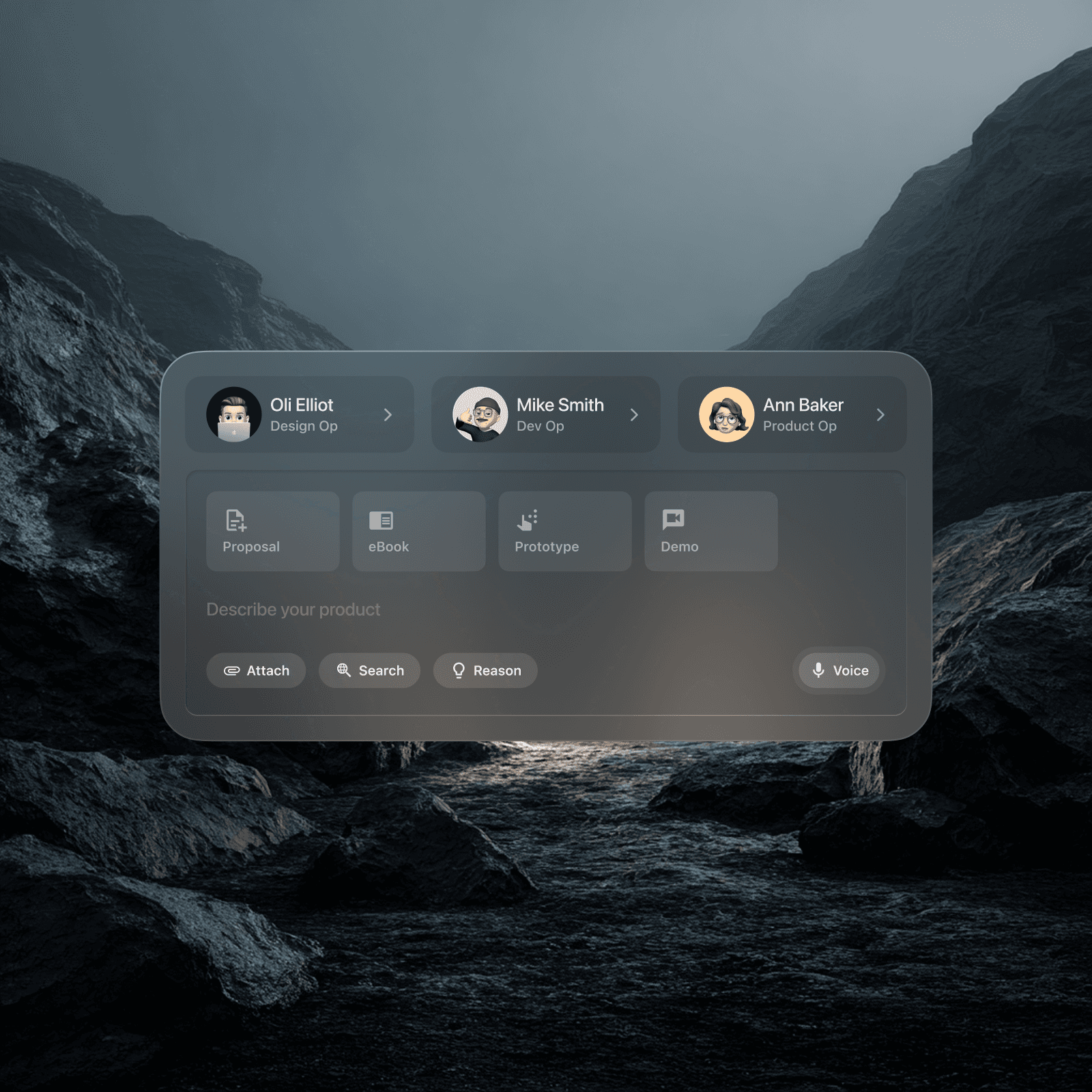
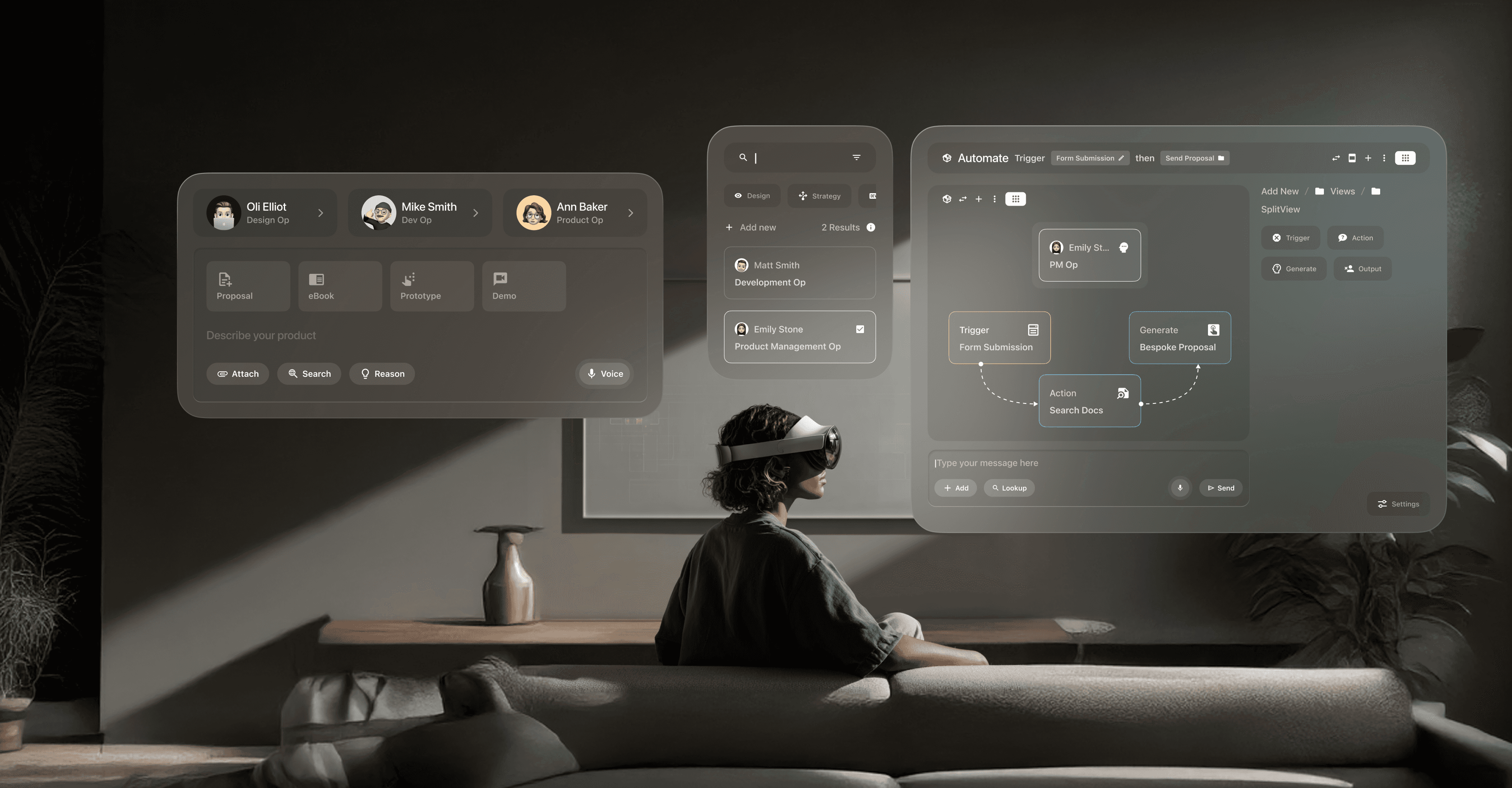
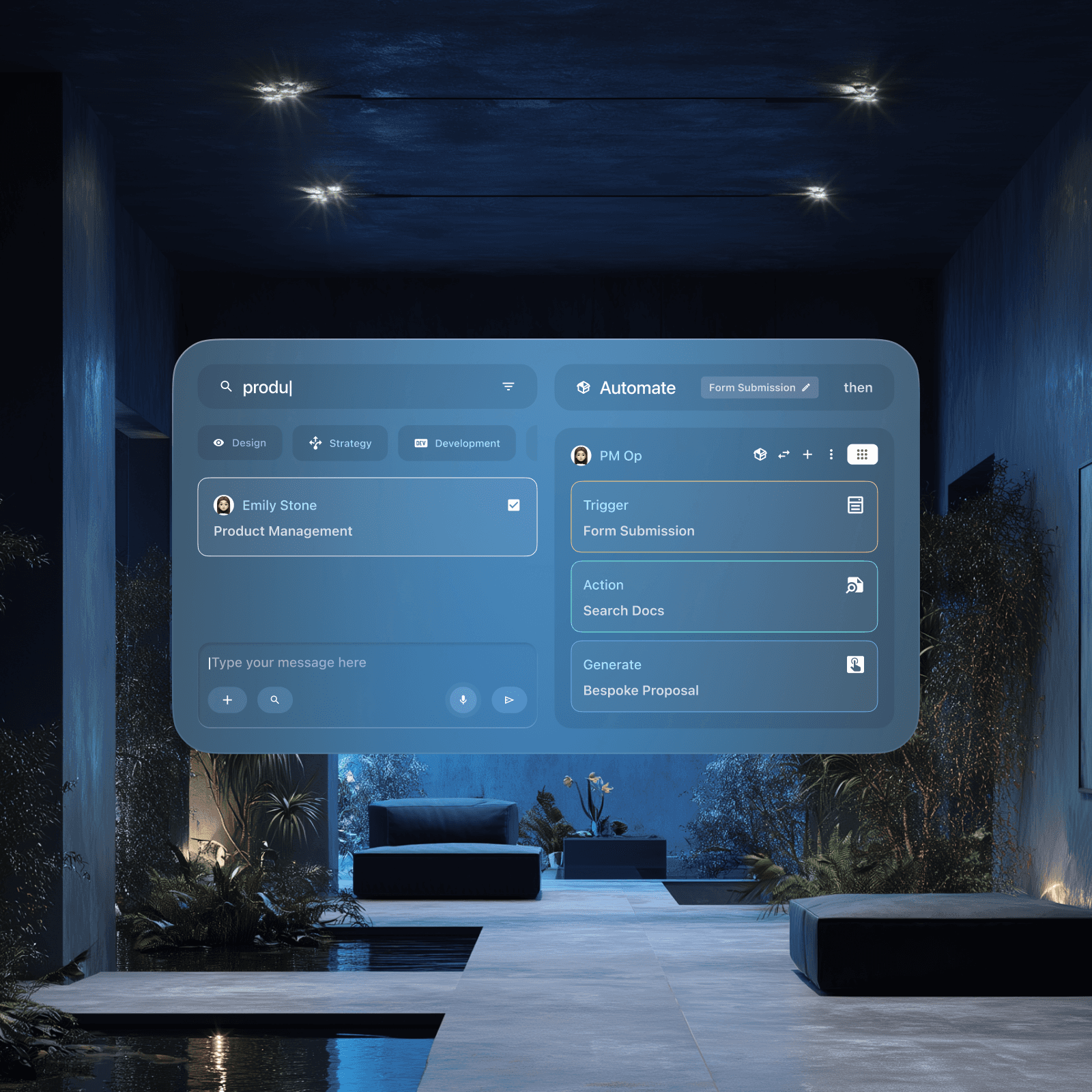
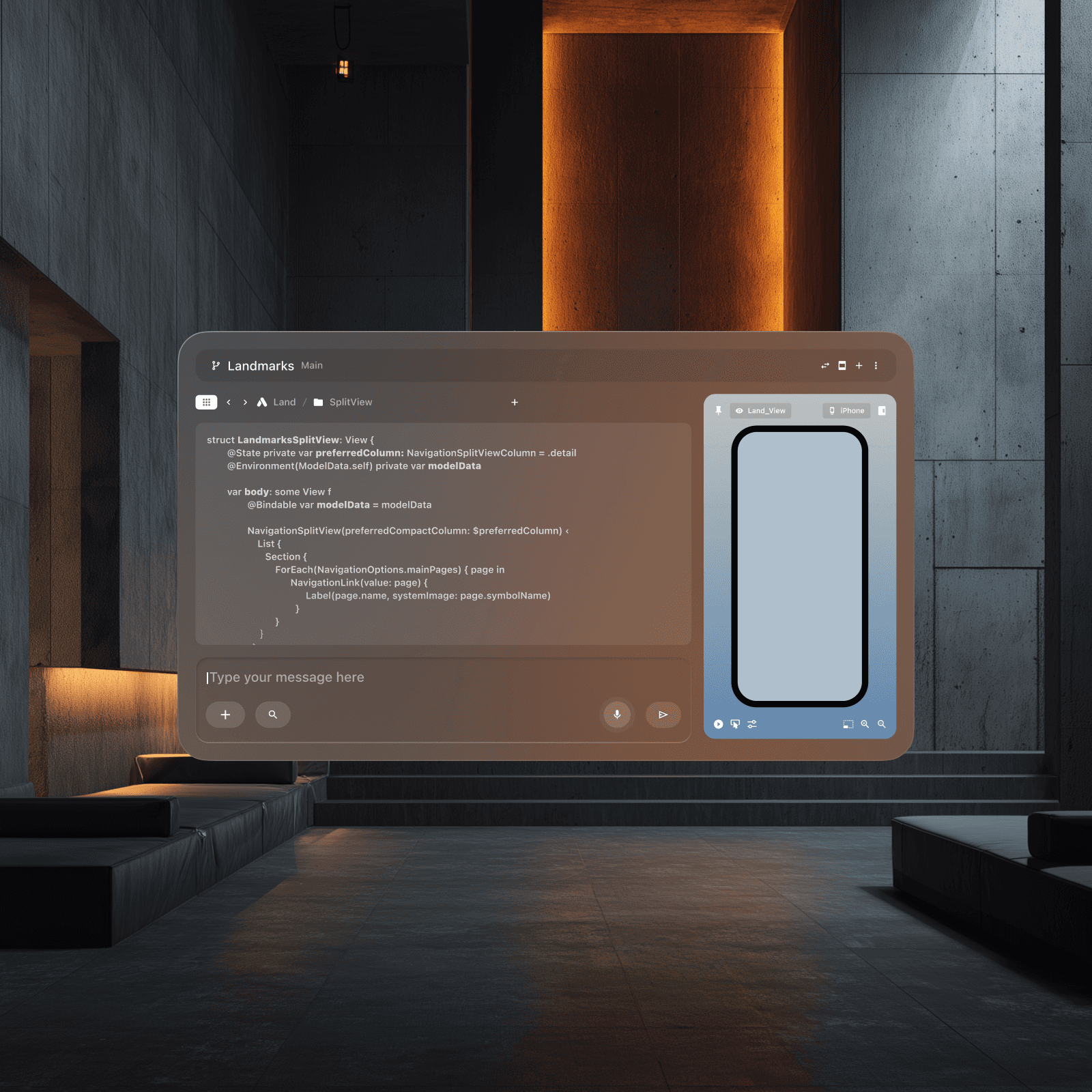
The spatial OS is organised around three Ops: Design, Dev, and Product. Selecting a role is not a preference setting, it is a routing decision. Design Op directs prompts toward proposals, eBooks, and demo assets. Dev Op connects to a live code engine rendering SwiftUI output alongside a real-time device preview. Product Op activates the Automate builder, a three-node chain (Trigger, Action, Generate) that converts a form submission into a document search and outputs a bespoke proposal. The LLM receives the same natural language input in each case. The Op context determines what it produces and in what format.

Julian Vance
Senior ML Engineer
Diagnoses complex agent failures and optimises reasoning loops.
Trace Observability
Prompt Engineering
Latency Optimisation

Elena Rodriguez
Compliance Specialist
Audits autonomous outputs for accuracy and redlines hallucinations.
Redlining Logic
HITL Verification
Domain Alignment

Marta Chen
Head of AI Strategy
Benchmarks models in the Arena to ensure operational reliability.
Model Benchmarking
KPI Monitoring
Token Unit Economics

Common Tasks as Agentic Workflows
The shift from tool-based to agentic work means tasks that previously required five manual steps become a single triggered chain. A product manager describing a feature no longer opens four tools in sequence and waits. The Automate panel converts that description into a Trigger event, runs a Search Docs action against existing team materials, and generates a formatted proposal. Meeting notes follow the same logic: instead of a post-call summary, the Recording mode structures notes, discussion questions, and resource links in real time during the call. The LLM is not an assistant you query after the work. It runs alongside it.

Language as the Operating Layer
Natural language is the single input modality across all three Op modes. The text field does not change shape between roles. Attach, Search, Reason, and Voice are constant. What changes is what the model does with the input: generate a proposal in Design Op, produce annotated SwiftUI code in Dev Op, or chain a workflow in Product Op. Voice routes directly into the Recording panel, so spoken conversation during a meeting becomes structured output without a separate transcription step. The user does not need to know which tool handles which task. They describe what they want; the OS decides the pipeline.

The Visual Consequence
When the model handles task routing, the interface reduces to its minimum. The command palette is a frosted glass panel: three role cards, four output-type buttons, a text field, and a four-action input bar. No sidebar, no menu hierarchy, no settings panel. The background environment (rocky terrain, blue interior, warm industrial space) carries the mode signal instead of labels or tabs. The panel is designed for Vision Pro, floating at arm's length with two panels composited into the AR field simultaneously, but the layout transfers to desktop without structural change because there is no navigation shell to adapt.

What Was Designed
The outcome is a spatial OS concept with three active Op modes, a live code generation surface with device preview, a three-node agentic automation builder, and a real-time meeting synthesis panel. A feature matrix maps each role to its LLM pipeline and output types. The floating panel architecture scales to new roles without adding navigation: a Data Op or QA Op requires only a new persona card and a mapped pipeline. The spatial computing context is not decorative. It is the premise. An OS that knows who is using it and what they are trying to build does not need a dashboard.