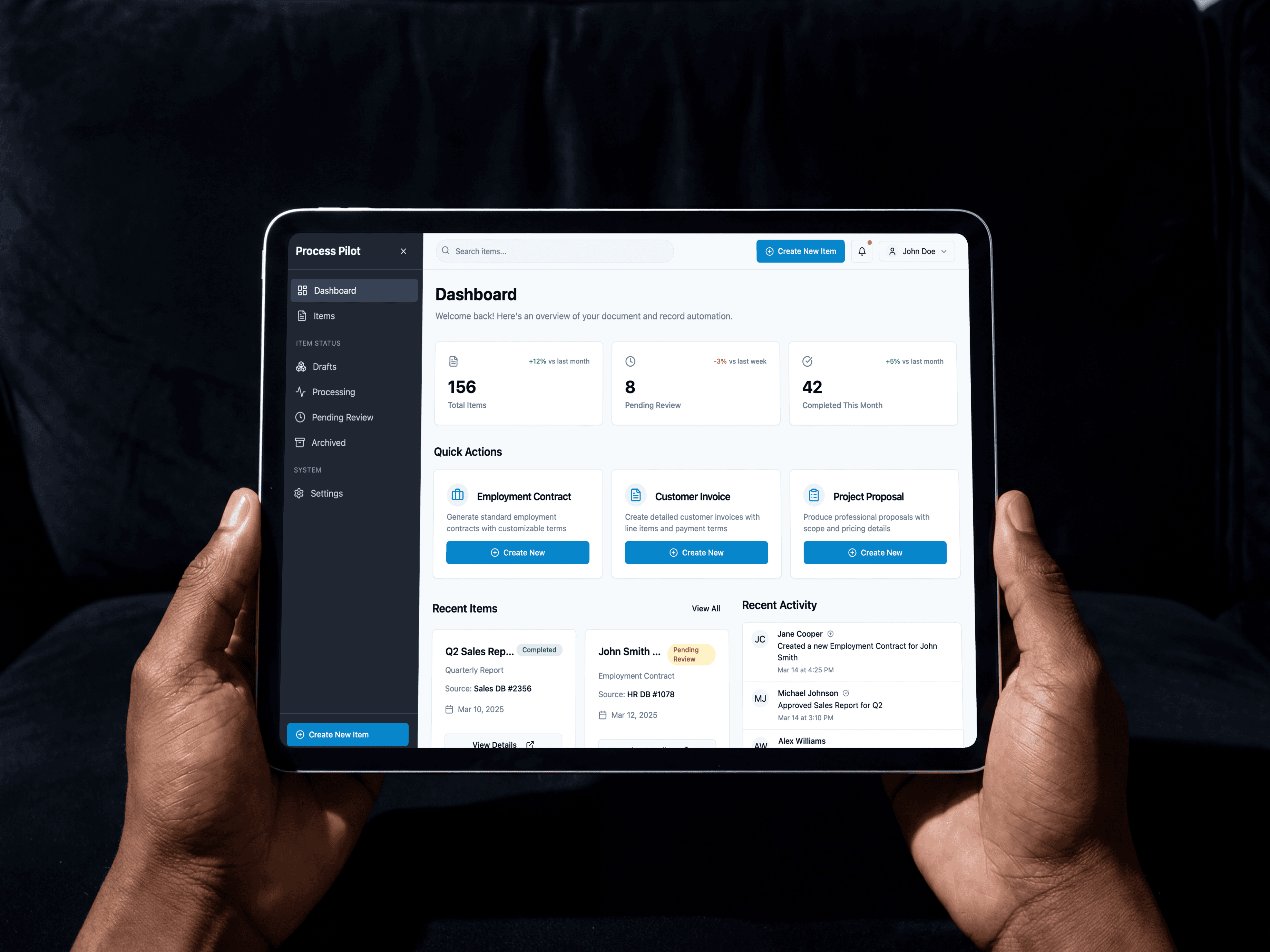
Process Pilot is a streamlined document automation platform designed to standardise the creation of critical business records. By coupling a linear, wizard-based interface with intelligent "Source Record" linking, the platform allows teams to generate legally binding contracts, invoices, and complex proposals in seconds, ensuring 100% data accuracy and brand consistency.
Year
04.25
Scope
Rapid Prototyping, Admin Automation, AI Integration, System Architecture
Timeline
2 weeks

The Challenge & Insights Gathering
Organisations often struggle with "document drift"—where outdated templates are used, and data is manually copy-pasted from project management tools into Word documents, leading to critical errors. Discovery Workshops & Stakeholder Interviews We audited the administrative workflows of HR managers and Sales Directors. A massive inefficiency was uncovered: Users were spending 40% of their time re-typing data that already existed elsewhere in the system (e.g., Client Name, Pricing). The goal became engineering a "headless" document creator that pulls existing data to pre-fill templates, leaving the user to only configure the variables that matter.

Defining the Ecosystem: Personas & Roles
To structure the automation pipeline, we defined three core user archetypes: the Sales Director (Michael Ross), who prioritizes speed and modularity for high-volume proposals; the HR Specialist (Sarah Jenkins), who requires strict template adherence and secure archiving for sensitive records; and the Operations Lead (System Admin), who focuses on system reliability while configuring templates and data connections.

Julian Vance
Senior ML Engineer
Diagnoses complex agent failures and optimises reasoning loops.
Trace Observability
Prompt Engineering
Latency Optimisation

Elena Rodriguez
Compliance Specialist
Audits autonomous outputs for accuracy and redlines hallucinations.
Redlining Logic
HITL Verification
Domain Alignment

Marta Chen
Head of AI Strategy
Benchmarks models in the Arena to ensure operational reliability.
Model Benchmarking
KPI Monitoring
Token Unit Economics

Iteration & Strategic Pivoting
During the initial wireframing, the product was designed as a standard form-builder, where users typed every detail manually. However, beta testing revealed that this was barely faster than using Microsoft Word. The Pivot: Users didn't want a better typewriter; they wanted a data connector. We pivoted the architecture to introduce the Source Record Integration (Screen 3). Instead of typing a client's name, the user searches for the Project ID (e.g., Website Redesign ID: src-6). The system then "hydrates" the document template with all known data associated with that ID, transforming the tool from a writer to an orchestrator.

Mapping the User Flows
To manage the complexity of document variables without cognitive overload, the system employs a strict 3-step linear wizard that enables automated, context-linked document assembly for creators while providing managers with clear dashboard visibility to safely oversee lifecycles and approvals.

Interface Solutions & Accessibility
Form fatigue is a major issue in enterprise software. The interface required a layout that felt light, airy, and approachable. Designing for Linear Focus We stripped away all non-essential navigation during the creation process. The "Create New Item" screen utilises a centered canvas with a clear, numbered stepper (1, 2, 3) at the top. Input fields are oversized with clear labels, and secondary actions are hidden. The use of card-based selection for "Item Type" (Screen 2) with distinct iconography helps users visually distinguish between financial documents (Invoices) and legal documents (Contracts) instantly.