
Recruitment agencies have a presentation problem that nobody talks about. The sourcing is hard, but the client handoff is where relationships break.
An agency finds the right candidate. They know it. But they're presenting that person through a generic third-party platform with someone else's logo on it, in a format that was designed for everything and optimised for nothing. The candidate looks like a data row. The agency looks like a middleman. The client makes a slower decision than they should.
That gap, between internal pipeline and external presentation, is where TalentFlow began. But it isn't the only thing wrong.
The Manual Sourcing Bottleneck: Recruiters spend hours cross-referencing static CVs against complex job requisitions by hand. Plenty of tools claim to automate it. Few are trusted enough to actually be used.
The Black Box Problem: The tools that do offer matching give a percentage and nothing else. A 74% match means nothing if you don't know what it's measuring, so the score gets ignored and the manual review happens anyway.
Brand Dilution: Most tools offer no white-labelling. Every candidate shortlist reaches the client through a third-party interface, so the agency's identity is invisible at the most important moment of the relationship.
Three roles, three completely different relationships with the same data
Before any UI work, I mapped three distinct users and what success looks like for each at the end of a working day.
The recruiter needs to move fast. They're scanning profiles, qualifying candidates, composing outreach, updating pipeline stages. Speed and density are their primary concerns. A recruiter who has to click through four screens to reach a candidate's key skills will find a workaround or leave the platform.
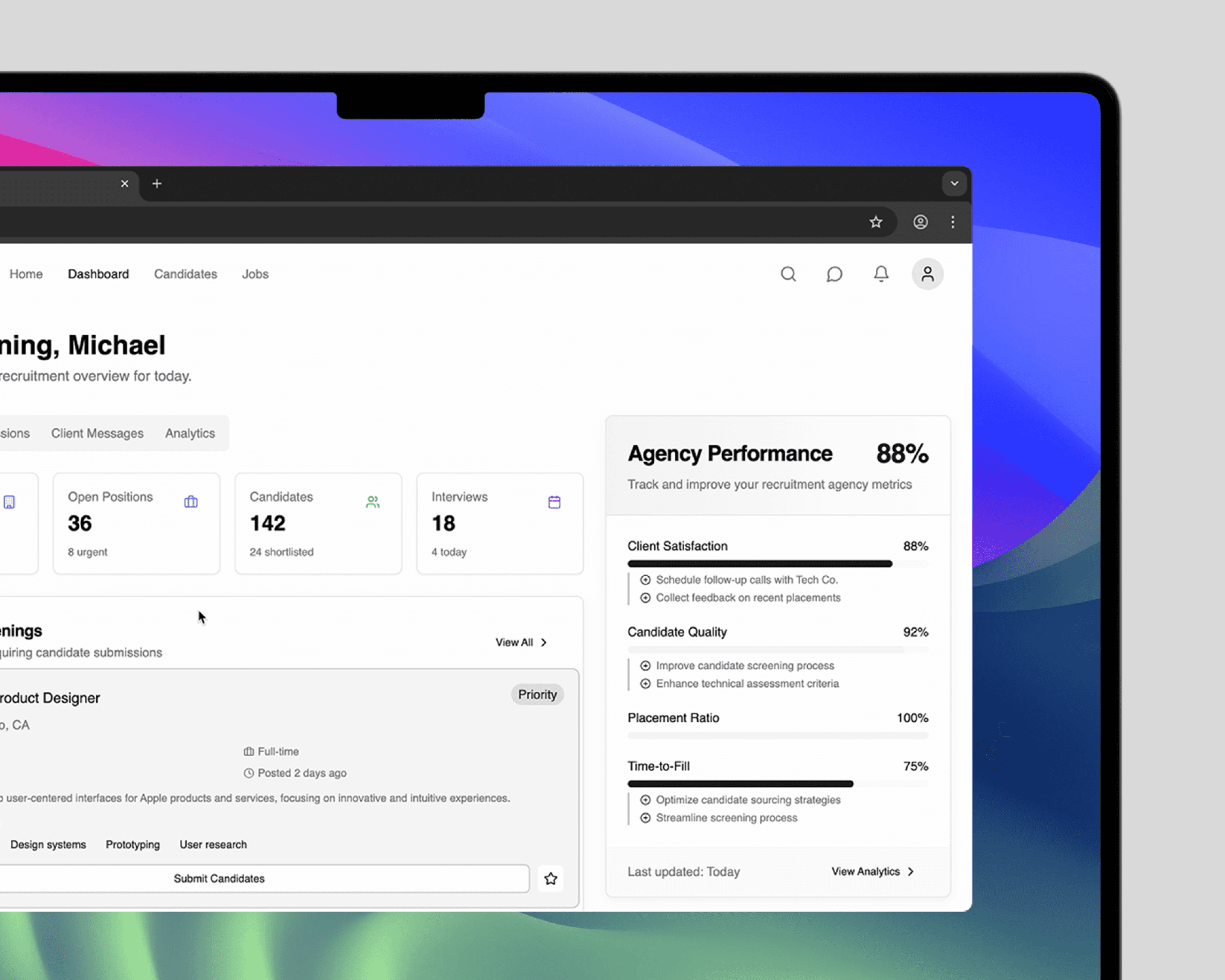
The agency director needs visibility without noise. They're not working the pipeline themselves, they need to see where things are across multiple roles and clients at a glance, spot problems before they become crises, and report upward with confidence.
The candidate has the most fragile relationship with the platform. They never chose to be in it. Their professional representation depends entirely on how well their information is surfaced. Getting their profile layout wrong isn't a UX problem, it's a professional dignity problem.
Those three frames shaped every hierarchy decision in the interface.
The candidate card was redesigned four times before it worked
The core unit of the platform is the candidate card, the compressed view a recruiter sees when scanning a shortlist. Getting it right meant deciding what deserves the first two seconds of attention and what should wait until something catches the eye.
First pass: too much information, no clear hierarchy. Second pass: too sparse, key skills hidden behind a click. Third pass: better density, but the AI match score was a single number with no context, which makes it easy to dismiss. Fourth pass: the Explainable Match. Skills Match, Experience, and Culture Fit as separate confidence bars, each derived from explicit criteria in the job requisition.
That last change is the one that matters. A score you can interrogate is a score you might act on. It also changes what a recruiter can say to a client: "the match flagged her Design Systems experience at 94% against your brief" is a different conversation from "she scored 74%."
The white-label system was built token-first
For TalentFlow to work as a genuinely white-label product, the visual system had to be entirely neutral at its base. No opinionated accent colours, no brand-forward components, nothing that would fight with an agency's identity when applied on top.
I built the component library around design tokens, every colour reference pointing to a variable rather than a fixed value. An agency uploads a logo, sets a primary and accent hex, and the interface recolours without breaking contrast ratios. I checked it against deliberately awkward palettes, a neon green primary, a near-black accent pair, a pale beige background, because those are the ones that break a naive implementation.
The candidate profile view under white-label needed particular attention. It's the screen a client sees when evaluating shortlisted candidates, effectively the agency's pitch document. Layout, typography hierarchy, and the way skills are presented all needed to feel polished enough to sit in a boardroom, regardless of whose branding is applied.
Outreach was a separate problem hiding inside the platform
Recruiters spend a significant portion of their day writing outreach messages. Most follow the same structure but with enough personalisation to not feel templated. That's a slow, repetitive task that compounds across a high-volume pipeline.
The outreach suggestion engine was scoped late and ended up being the feature I'd most want to keep. Given a candidate profile and a requisition, it drafts a personalised opening that references specific skills and shared background rather than generic flattery. The design assumption is that a recruiter edits before sending, so the draft is written to be edited, not to be final.
The principle: AI in professional contexts has to earn trust before it gets autonomy
The Explainable Match is the right call not just for usability but philosophically. In recruitment, a wrong recommendation has real consequences for real people. Showing the reasoning, making the logic legible, means a recruiter can catch errors and override them confidently. It also means they can advocate for the recommendation when they agree with it.
Opaque automation in a high-stakes professional environment gets rejected, not adopted. Transparency is what turns a tool into a trusted colleague.