
The AI skills gap is real. The credentialing system meant to close it is broken in a way that makes it worse.
Hiring managers don't trust course certificates. Learners know this, which is why finishing a course you worked hard for can feel deflating. The certificate goes on LinkedIn. The recruiter scrolls past it. The gap between "I learned this" and "I can prove I learned this" stays exactly as wide as before.
The pattern is visible from both sides. Platform badges get ignored. Self-taught professionals finish courses and still can't answer "can you demonstrate this?" in an interview. The market for AI education is expanding and simultaneously failing to produce credible evidence of competency.
The Verification Deficit: A certificate that requires only video playback to earn is not evidence of anything. Employers know it. They just don't have an alternative to point to.
The Translation Gap: Learning a skill and being able to articulate that skill professionally are different capabilities. Most platforms help with the first and ignore the second entirely.
Passive Interface Design: The worst thing a learning platform can do is design itself to feel like entertainment. Endless resource lists, autoplay videos, sidebar navigation full of courses. The interface trains learners to consume passively, which is the opposite of what competency development requires.
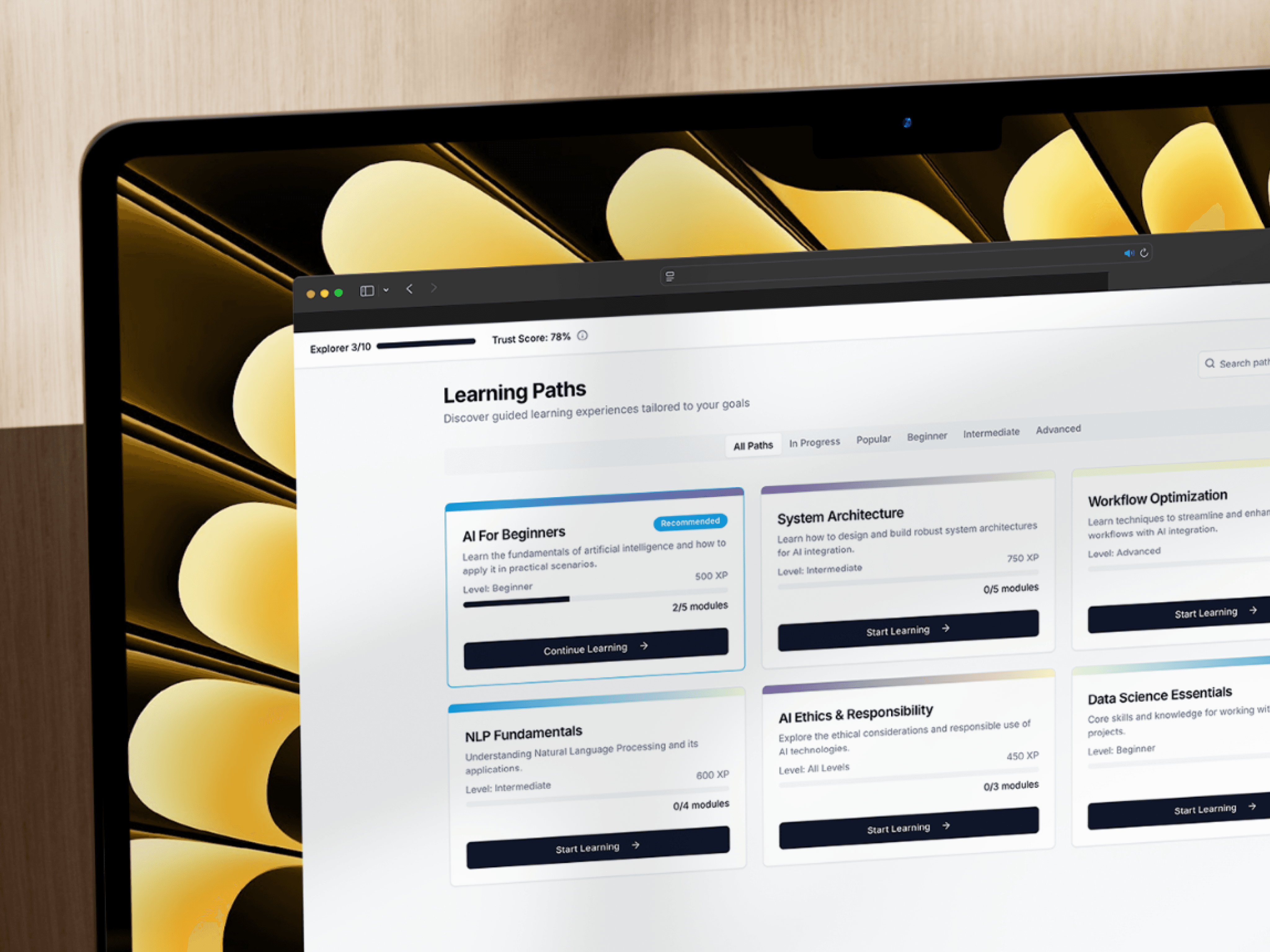
The Trust Score was the concept everything else had to support
Before any screen design, I needed to resolve a conceptual question: what does verified competency actually look like? Not the certificate, the underlying signal that makes the certificate mean something.
The Trust Score is an algorithmic measure that builds through active completion, not passive watching. You can't earn it by finishing a video. You earn it by demonstrating understanding, through exercises, applied projects, assessments that require producing something rather than selecting an answer. The score compounds across every module completed, creating a cumulative professional reputation rather than a collection of isolated badges.
That distinction, cumulative versus isolated, was the design brief in one word. Everything in the interface had to reinforce the sense that learning here builds something durable, not just marks things as done.
The learning environment was stripped to almost nothing on purpose
The active module view has no sidebar. No recommended courses. No progress summaries from other modules. Nothing that isn't directly related to the content in front of the learner.
That level of visual restraint is a deliberate fight against the patterns that dominate e-learning. The ample white space, the high-contrast typography, the muted palette, none of it is aesthetic preference. It's cognitive load reduction. Dense technical content like system architecture or prompt engineering needs the learner's full attention. The interface should make that easier, not compete with it.
Progress tracking lives in a subtle top-bar indicator, Explorer 3/10, 0/5 Complete, always visible but never demanding attention. You can check where you are without the interface making you feel guilty about where you aren't.
The public/private toggle is what makes it a portfolio tool
A persistent toggle in the dashboard switches between private learning mode and public portfolio mode. Same data, two completely different presentations. In private mode, it's a personal study environment. In public mode, it's a verifiable portfolio a recruiter can link to directly from a job application.
The public view surfaces the Trust Score prominently, lists verified skills with the competency areas each one covered, and shows active learning paths in progress, signalling not just what someone knows but that they're continuing to develop. That "currently learning" signal is the part I think does the most work. It communicates growth in a way a static certificate cannot.
The toggle itself had to be unambiguous, because the failure mode is someone accidentally publishing incomplete progress. I went through several forms, a switch, a button, a tab pair, before landing on a clearly labelled persistent toggle with a distinct colour state for each mode. Ambiguity there isn't a polish problem, it's a trust problem.
Gamification has a credibility ceiling that most platforms hit and ignore
There's an obvious pull toward aggressive gamification: leaderboards, streak counters, daily challenge notifications. I built some of it and cut it. People learning to qualify for senior technical roles don't want to feel like they're playing Duolingo, and the moment the interface reads as juvenile, the credential it produces reads as juvenile too.
The XP system that remained is deliberately understated. No animations celebrating level-ups. No confetti. Points accumulate quietly and feed the Trust Score without fanfare. The accomplishment is the score, not the earning of it.
The balance being aimed for: engaging enough that progress feels tangible, credible enough that a hiring manager would take the score seriously as professional evidence. Too far in either direction and the whole concept fails.
What the project clarified: active validation is the only path to institutional trust
The Trust Score works because it can't be gamed by passive consumption. That property, resistance to gaming, is what would make it credible to employers. Building that resistance into the architecture early, rather than as a bolt-on, is what separates this from another badge generator with a better UI.
Whether employers would actually accept it is the open question, and it's not one design can answer on its own.